
Craft Foundations
How I work and what informs that work
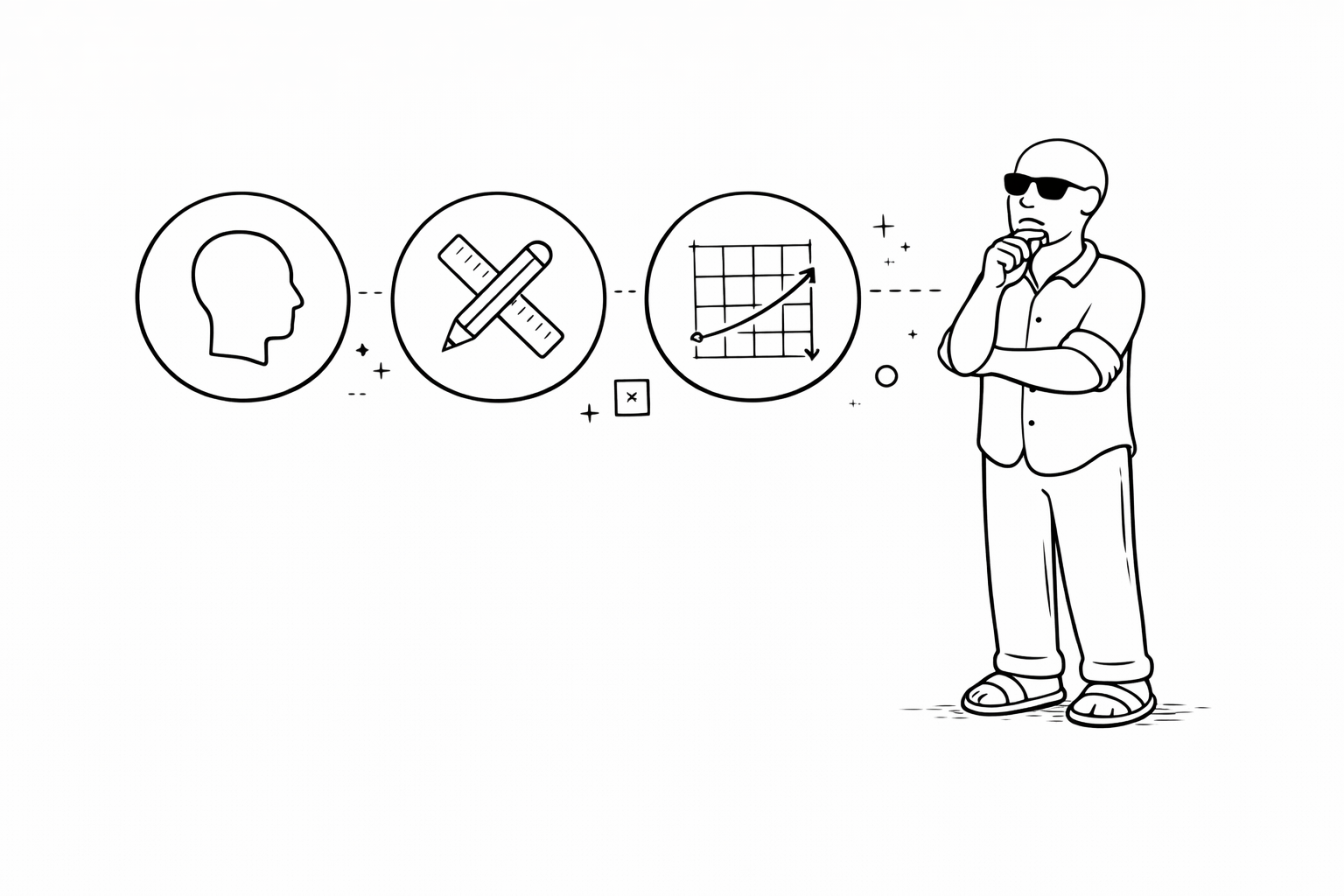
My first primary design tool wasn’t Figma. It was a plain HTML file and a browser.
I learned design by writing the markup, refreshing the page, adjusting spacing by hand, and watching the result render in real time. Form and function weren't separate disciplines — they couldn't be. If something didn't work, it was my responsibility to fix it. There was no handoff.
Before that, my instincts were visual. I studied visual art and technical drawing — not professionally, but seriously. Drafting taught me precision. Art taught me that composition, proportion, and restraint aren't constraints on creativity; they're what makes creativity legible. When the early web emerged, those instincts met code, and I became what used to be called a webmaster — designing interfaces, writing front-end code, managing systems, handling branding, and shipping complete products from end to end.
I've always been drawn to visual simplicity, though not minimalism as trend. Minimalism as discipline. The difference matters. It's not about removing things because spare is fashionable. It's about understanding what's actually doing work in a design and having the conviction to remove everything that isn't. That sensibility shaped my early web work and still governs how I think today — because I've built from the inside, I've never been able to pretend that a beautiful surface is enough if the structure underneath doesn't hold.
Today, a growing part of my work involves AI-forward systems and agentic workflows. I don't see AI as a feature to bolt onto an interface because the market demands it. I see it as a material with its own properties — something users form a relationship with over time, something that reshapes trust, agency, and expectation in ways that a static interface simply doesn't.
Designing for that requires thinking carefully about how a system behaves before you think about how it looks. Architectural clarity before visual expression. That's not a new instinct for me. It's the same one I developed refreshing HTML files in a browser twenty-five years ago.
The scale has changed. The mindset hasn't.
I still think close to the product. Close to the code. And aware that every design decision eventually becomes something someone has to build, maintain, and live with — ideally, for a long time.